
MICROSCALE, BIOELECTRIC FIBERS
Our advanced fiber technology draws from the textile and telecommunications industries to deliver the next generation of neural interfaces. Our fibers are hair-thin, flexible, and biocompatible–designed to move and seamlessly integrate with the human body. The technology offers a new paradigm for minimally invasive and multifunctional neural interfacing for a wide range of applications.
EVSTIM
Next-generation neuromodulation:
designed for the human body.
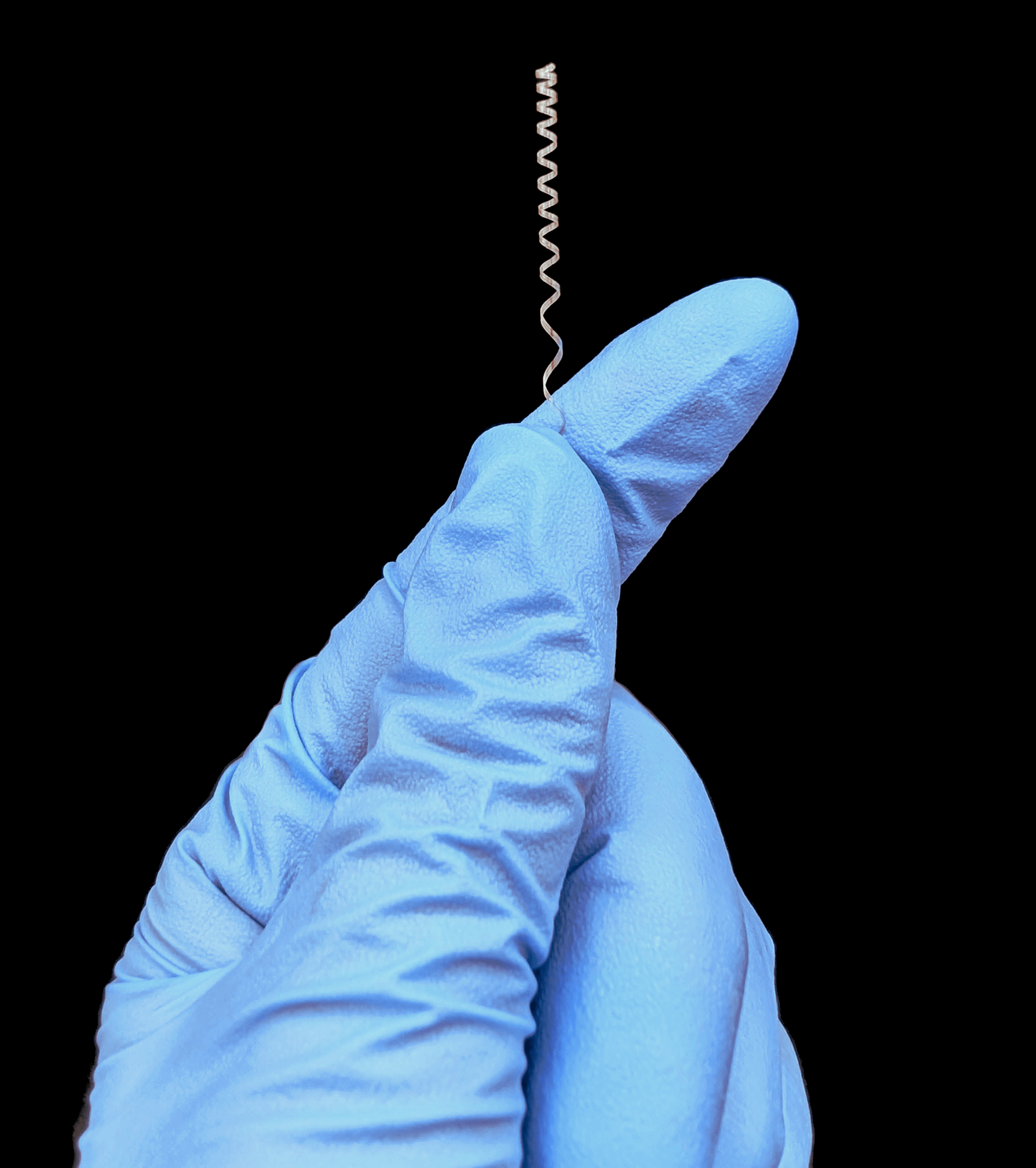
The evStim device represents a breakthrough in minimally-invasive neuromodulation. While today’s neuromodulation devices require invasive surgical approaches, evStim can be delivered through an endovascular procedure with just a small incision, similar to a routine stent placement.
The device is made from a hair-thin bioelectronic fiber coiled into a helical shape to anchor inside the blood vessel, where it delivers precise stimulation through the vessel wall to the target tissue.
IO fiber
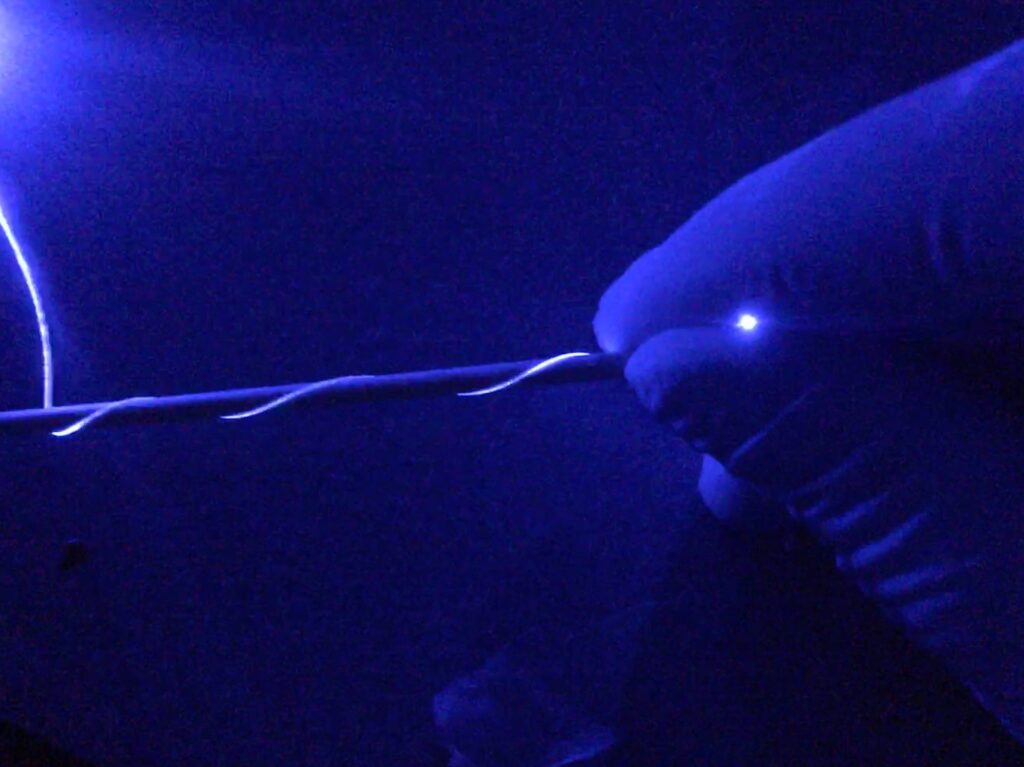
The IO Fiber is an all-in-one research solution for neuroscientists and beyond.
This multifunctional device combines electric and optogenetic stimulation and recording with a fluidic channel, enabling diverse experiments from a single MRI-compatible device.
Scientific Publications
Based on a decade of research at MIT, our fiber technology has been used to interface with the brain, spinal cord, nerves, muscles, and GI tract.
Frequently Asked Questions
What makes NeuroBionics’ endovascular neuromodulation approach different from traditional deep brain stimulation (DBS)?
Traditional deep brain stimulation (DBS) reaches its target by surgery: a neurosurgeon drills through the skull and threads rigid electrodes deep into the brain, connected to a pulse generator implanted under the skin. It is an established and effective therapy, but it carries the risks and recovery of open neurosurgery. NeuroBionics is developing an endovascular alternative – the evStim, a hair-thin, flexible bioelectronic fiber delivered to neural targets through the body’s existing network of blood vessels using a catheter, the same route interventional teams already use to reach the brain. The goal is to interface with neural circuits at a fraction of the procedural invasiveness, while supporting more than electrical stimulation alone.
Please note: NeuroBionics’ technology is in preclinical development and is not an approved DBS replacement.
How can brain stimulation be delivered through a blood vessel without open brain surgery?
The brain is one of the most densely vascularized organs in the body, so almost every region sits close to a blood vessel. Interventional neurology already exploits this: procedures like stroke thrombectomy and aneurysm stenting routinely navigate catheters through the vasculature to reach the brain without opening the skull. NeuroBionics applies the same principle to neural interfacing. Our evStim device is thin and flexible enough to travel these vessels and interface with the surrounding neural tissue from within the vessel wall, removing the need for a craniotomy. This endovascular route is what allows stimulation and recording to be delivered through a minimally invasive, catheter-based procedure rather than open brain surgery.
What neurological conditions could NeuroBionics’ technology eventually help treat?
NeuroBionics’ evStim is an investigational endovascular neuromodulation device currently under evaluation, and is not yet approved for clinical use. Looking ahead, endovascular neuromodulation is being explored across the field as a potential future approach to the kinds of circuit-based disorders that neuromodulation already addresses or aspires to, including movement disorders, epilepsy, chronic pain, and certain psychiatric conditions. Any clinical application of evFiber would depend on the outcome of formal clinical trials and regulatory review. NeuroBionics is advancing toward that future through preclinical research, with First-in-Human studies on its roadmap. The broader intent is to widen who can benefit from neuromodulation by lowering the surgical barrier to reaching the brain.
What are bioelectronic fibers, and why are flexible neural interfaces important for long-term implantation?
Bioelectronic fibers are hair-thin fibers engineered to carry functional channels to sense and influence the nervous system. The evStim carries electrical channels for recording and stimulation, while the IO Fiber device, NeuroBionics’ research probe, also features optical and microfluidic channels. Flexibility is key: brain tissue is soft and constantly micro-moving, while conventional probes are rigid. That mechanical mismatch grinds against tissue, triggering inflammation and scar formation (glial encapsulation) that gradually walls the device off and degrades its signal. Flexible fibers move with the tissue instead of against it, reducing chronic irritation and improving the stability and biocompatibility of the interface over time. For any device meant to remain in the body, that durability is essential.
What is the IO Fiber, and how does it combine electrical, optical, and chemical neural interfacing in a single probe?
The IO Fiber is NeuroBionics’ research-use-only neural probe: a single hair-thin fiber that integrates three modalities at the same site. Embedded electrodes handle electrical recording and stimulation; optical channels deliver light for techniques such as optogenetics; and microfluidic channels enable precise, localized chemical or drug delivery. Combining all three in one fiber means researchers can interrogate a neural circuit electrically, optically, and chemically without inserting separate devices or repeated surgeries.
Why are multifunctional neural probes important for modern neuroscience research?
Modern circuit neuroscience increasingly demands more than one capability at once — recording activity, stimulating it, delivering light to optogenetically defined cells, and applying compounds, all at the same location. Achieving that with separate single-purpose tools means multiple insertions, each adding tissue damage, and modalities that never quite line up in the same spot. A multifunctional probe like the IO Fiber co-locates these functions in one device, so stimulation, recording, light, and chemistry act on the same population of neurons. The result is cleaner experimental design, less trauma to the tissue under study, and richer causal data about how circuits actually work.
How is NeuroBionics using advances from telecommunications to build next-generation neurotechnology devices?
NeuroBionics’ fibers are made using thermal fiber drawing — the same manufacturing technique that produces the optical fiber behind global telecommunications. Instead of applying this process to silica and glass, NeuroBionics uses a range of polymer, and organic and metallic materials. The process starts with a macroscale “preform” that contains the device’s full architecture in cross-section: electrodes, optical waveguides, and microfluidic channels. Heating and drawing that preform stretches it into hundreds of meters of thin, uniform fiber that preserves the original layout at microscopic scale. Borrowing this mature, scalable technique lets NeuroBionics pack multiple functions into a single hair-thin probe with precision and repeatability — bringing decades of progress from two established industries to bear on next-generation neurotechnology.